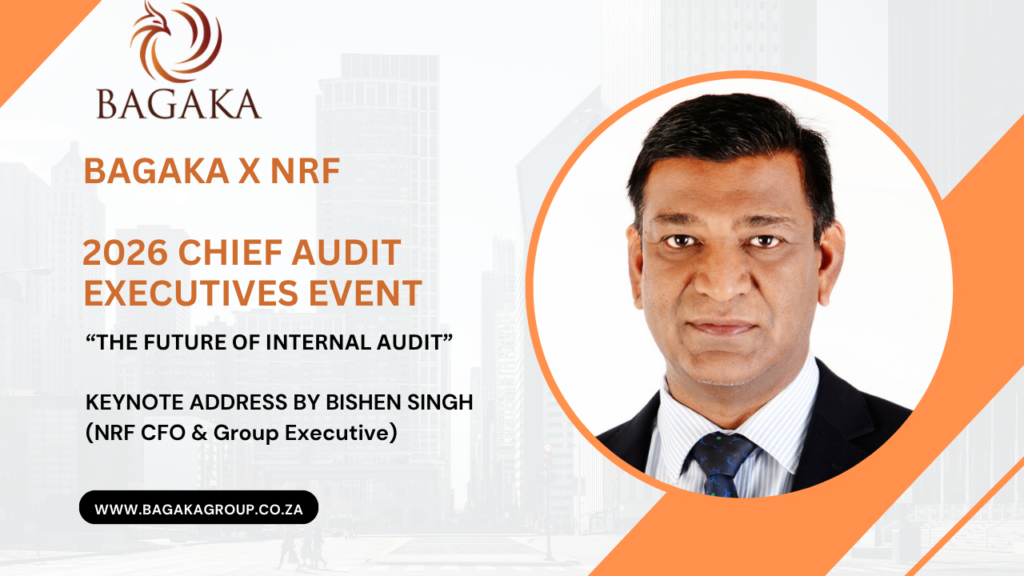
Internal Audit's Strategic Evolution: A Reflection from the Bagaka Group x NRF 2026 CAE Leadership Forum
At the Bagaka Group x NRF 2026 Chief Audit Executives Leadership Forum, one message stood out above all others.
In his keynote address, NRF Chief Financial Officer and Group Executive: Finance & Supply Chain, Bishen Singh, challenged audit leaders to rethink the role of Internal Audit in modern organisations.
Rather than viewing Internal Audit as a function focused primarily on compliance and control monitoring, he argued that organisations should see it as a contributor to governance, innovation and organisational resilience. As he stated:
“Internal Audit is not just about assurance, it’s about shaping the future of governance, innovation, and organizational resilience.”
The statement captures an important shift taking place across the profession.
Beyond Traditional Assurance
Historically, Internal Audit has often been associated with compliance reviews, control assessments and the identification of findings. While these responsibilities remain important, the expectations of boards, executives and stakeholders have evolved significantly.
The Global Internal Audit Standards and the broader evolution of the profession increasingly position Internal Audit as a function that provides not only assurance, but also insight and foresight. Organisations are looking to Internal Audit to identify emerging risks, provide strategic observations and contribute to stronger decision-making.
The keynote reinforced this reality by encouraging Chief Audit Executives to engage more actively in strategic discussions and organisational planning. Rather than observing from the sidelines, Internal Audit is expected to participate in conversations that influence the future direction of organisations.
Governance Requires Strategic Assurance
The keynote’s message aligns strongly with the principles articulated in the King V Code on Corporate Governance.
King V adopts an outcomes-based approach to governance, emphasizing the realisation of four governance outcomes: Ethical Culture, Performance and Value Creation, Conformance and Prudent Control, and Legitimacy. Governance is therefore not measured solely by the existence of controls or adherence to policies, but by whether governance structures contribute to sustainable organisational value and responsible decision-making.
This perspective reinforces the evolution of Internal Audit from a traditional assurance function to a strategic governance enabler. King V specifically recognises the importance of effective assurance arrangements, risk governance, compliance oversight, and an independent Internal Audit function that contributes to the effectiveness of governance, risk management, and internal control processes.
Bishen Singh’s challenge to CAEs to become active contributors to organisational strategy rather than passive observers reflects this broader governance philosophy. Organisations increasingly require Internal Audit functions that provide assurance over not only financial and compliance matters, but also strategic objectives, organisational resilience, technology adoption, emerging risks, and long-term value creation.
In this context, Internal Audit becomes more than an oversight mechanism. It becomes a critical component of the organisation’s governance architecture, providing independent insight that helps governing bodies fulfil their responsibilities while promoting sustainable performance and prudent control.
The Public Sector Imperative
The discussion is equally important in the public sector.
South Africa continues to face governance challenges relating to procurement management, contract management, performance oversight and consequence management across various institutions. Internal Audit functions are increasingly expected to provide proactive assurance over these high-risk areas and assist leadership in identifying weaknesses before they escalate into significant governance failures.
This is where the concept of strategic Internal Audit becomes particularly valuable.
An Internal Audit function that understands organisational objectives, funding pressures, procurement risks, technology challenges and service delivery expectations is better positioned to provide meaningful assurance than one focused solely on transactional reviews.
The profession’s value increasingly lies in helping organisations navigate uncertainty, anticipate risks and strengthen resilience.
Technology, Innovation and the Future of Internal Audit
Another important theme from the keynote was the impact of technology on the future of organisations and assurance functions.
As organisations increasingly adopt artificial intelligence, automation and advanced data analytics, Internal Audit must evolve alongside them. The profession can no longer rely solely on traditional audit approaches while organisations undergo rapid digital transformation.
The challenge for Internal Audit is twofold:
- To provide assurance over emerging technologies and related risks.
- To leverage technology to improve assurance activities themselves.
This requires new skills, new methodologies and continuous professional development.
A Strategic Opportunity for the Profession
Perhaps the most significant takeaway from the keynote is that the future relevance of Internal Audit is not guaranteed, it must be earned.
Organisations need Internal Audit functions that are independent, technically competent and strategically aware. They need professionals who understand governance while also understanding business, technology, risk and organisational performance.
This is why collaboration platforms such as the Bagaka Group x NRF CAE Leadership Forum are increasingly important. They provide opportunities for leaders across sectors to share experiences, challenge conventional thinking and collectively shape the future of the profession.
As Bishen Singh reminded delegates during his keynote:
“We want to inspire you guys as Chief Audit Executives, Audit and Risk Committee members, and board members, to view Internal Audit as a driver of strategic value creation, not just compliance.”
That challenge may well define the next chapter of Internal Audit.
Watch the Full Keynote
The full keynote address from the Bagaka Group x NRF 2026 Chief Audit Executives Leadership Forum is available on the Bagaka Group YouTube channel:
https://youtu.be/UymzQcyUtlc?si=H3Myd5BLIqJOZAQt
This article reflects on themes emerging from the keynote and is not intended to replace the discussion. We encourage governance professionals, Chief Audit Executives, Audit Committee Members and risk practitioners to watch the full address for the complete context and insights.